Laboratory 5
Objective:
This laboratory has two parts. For the first part students will use a He-Ne laser (λ = 633 nm) and a high-speed silicon detectors to measure the power of the laser light falling onto the detector, when the laser beam is not attenuated and when it is a attenuated by passing through different neutral density filters. For the second part, students will use components from the "Projects in Optics" kit and 2'' lens kit to build a simple Keplerian telescope, a terrestrial telescope with an erecting lens, and a Galilean telescope.
Equipment:
- Lens Kit
- Meter Stick, Ruler
- Detectors
- Power Meter
- Lens Kit
Open a Microsoft Word document to keep a live journal of your experimental procedures and your results. Include all deliverables, (data, graphs, analysis, outcome). Write a 'mini-reflection' immediately after finishing each investigation, experiment or activity, while the logic is fresh in your mind.
Procedure:
Part 1:
- Mount the laser onto the breadboard. Turn it on and leave it on, so that it warms up and stays warm. Use a beam stop to block the beam from traveling across the room.
- Set up the Tektronix TDS 210 Digital Oscilloscope.
Perform the functional check described on page 5 of the TDS-200 series user manual.
If you are not familiar with this scope, read through "Operating Basics", pages 23 - 36 in the user manual. -
 Position the
Thorlabs
DET210 high-speed silicon detector so that the laser beam hits the
photodiode. The photodiode is an ordinary diode in which the diode
junction is exposed to light. Place the filter
wheel with the neutral density filters between the laser and the detector so
that the laser beam passes through two empty holes. (Some stations are
equipped with a newer version of the
silicon detector.)
Position the
Thorlabs
DET210 high-speed silicon detector so that the laser beam hits the
photodiode. The photodiode is an ordinary diode in which the diode
junction is exposed to light. Place the filter
wheel with the neutral density filters between the laser and the detector so
that the laser beam passes through two empty holes. (Some stations are
equipped with a newer version of the
silicon detector.) - Connect the output of the DET210 to the input channel 1 of the scope,
using a 50 Ω cable and a tee with a 50 Ω
terminator. Press the Vertical Menu button for channel 1 and set the
probe attenuation to 1X. (See page 8, user manual.)
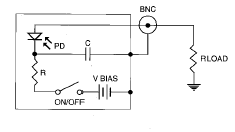
- Turn the detector on and measure the output voltage with the oscilloscope.
The photocurrent I flowing through the 50 Ω resistor is proportional to the
power P of the light illuminating the photodiode.
I = KPD P,
The proportional constant KPD is called the responsivity of the photodiode.
The voltage drop across the resistor displayed by the oscilloscope is V = IRload.
Use V = P KPD(λ) Rload to find the laser power P falling onto the detector.
Determine KPD at 633 nm from the graph below. Rload = 50 Ω.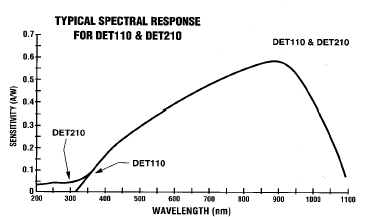
- The neutral density filters provide uniform attenuation over a broad
spectral range. The "optical density" is defined by
ND = log10(1/T), or T = 10-ND.
Here T is the transmittance.
Place filters with different optical densities between the laser and the detector and measure the power P falling onto the detector.
- Fill in the table below.
| ND | Detector Voltage V |
V/VND=0=P/PND=0 (measured) | P/PND=0 (expected) |
|---|---|---|---|
| 0 | 1 | 1 | |
| 0.2 | |||
| 0.3 | |||
| 0.4 | |||
| 0.5 | |||
| 0.6 | |||
| 1 |
- Plot P/PND=0 (measured) versus P/PND=0 (expected).
- Replace the DET110 with the the Thorlab S110 power meter to measure the output power of your
laser. (Some stations are equipped with a newer version of the power
meter.)

Check the power meter manual for operating instructions. Compare the value for the output power measured with the power meter with the value you obtained when measuring the output power with the DET210.
Part 1 Deliverables: (to be included in the your journal)
- Visuals: A picture of your setup (laser, ND filter wheel, detector, scope).
- Table: Filled out table.
- Analysis: Discuss your results. How does P/PND=0 (measured) compare with P/PND=0 (expected). Is the detector response linear? How does the output power measured with the Det210 compare with the output of the power meter? What could account for any differences?
Part 2:
Keplerian Telescope
Select lenses from the "Projects in Optics" kit and 2'' lens kit to build a Keplerian telescope with magnifying power MP ~ 5X - 10X. You can look up the surface data for these BK7 precision lenses.
Uncoated N-BK7 Plano-Convex Lens (newport.com)
Uncoated
N-BK7 Plano-Concave Lens (newport.com)
Uncoated
N-BK7 Bi-Convex Lens (newport.com)
Uncoated
N-BK7 Bi-Concave Lens (newport.com)
Use a 2'' lens for the objective and a 1'' lens for the eyepiece.

A Keplerian telescope
- Build your telescope on the optical rail. You can easily slide the components along the rail without destroying the alignment. Position the rail so you can view a target as far away as possible given the laboratory environment.
- Evaluate the performance of your telescope by viewing a distant object.
- Model your telescope with this Ray Optics Simulator. You can use ideal or real lenses.
Back of the envelope calculations:
Keplerian telescope, fe << fo,
object at infinity:
aperture stop: objective
entrance pupil: objective
exit pupil: 1/(fo + fe) + 1/xi = 1/fe,
xi = fe(fo + fe)/fo
diameter of exit pupil: (fe/fo) * diameter of objective
field stop: eyepiece
entrance window: 1/(fo + fe) + 1/xi = 1/fo,
xi = fo(fo + fe)/fe
diameter of entrance window: (fo/fe) * diameter of
eyepiece
field of view: tanθ = diameter of eyepiece/(fo
+ fe)
Example: 2'' objective, fo =
300 mm, 1'' eyepiece, fe = 50 mm, MP = 6X
exit pupil: xi = 58.33 mm
diameter of exit pupil: 8.5 mm
field of view: tanθ = 0.0726,
θ = 4.15o, full cone angle.
Terrestrial Telescope
Design and build a terrestrial telescope with magnifying power MP ~ 5X - 10X.

- Select a bi-convex erecting lens to be mounted between the objective and eyepiece.
- Evaluate the performance of your telescope by viewing a distant object.
Example: 2'' objective, fo =
300 mm, 1'' eyepiece, fe = 50 mm, 2'' erecting lens, fi
= 50 mm
aperture stop: objective
entrance pupil: objective
exit pupil: xi = 108.33 mm
diameter of exit pupil: 8.5 mm
field stop: eyepiece
field of view: tanθ = 0.039,
θ = 2.24o.
Galilean Telescope
- Design and build a Galilean telescope with magnifying power MP ~ 5X - 10X.
- Evaluate the performance of your telescope by viewing a distant object.
Back of the envelope calculations:
Galilean telescope, fe is
negative, |fe| << fo, object at infinity:
aperture stop: objective
entrance pupil: objective
exit pupil: 1/(fo + fe) + 1/xi = 1/fe,
xi = fe(fo + fe)/fo
diameter of exit pupil: (|fe|/fo) * diameter of objective
field stop: eyepiece
entrance window: 1/(fo + fe) + 1/xi = 1/fo,
xi = fo(fo + fe)/fe
diameter of entrance window: fo/|fe|) * diameter of
eyepiece
field of view: tanθ = diameter of eyepiece/(fo
+ fe)
Example: 2'' objective, fo =
300 mm, 1'' eyepiece, fe = -50 mm, MP = 6X
exit pupil: xi = -41.66 mm
diameter of exit pupil: 8.5 mm
field of view: tanθ = 0.1, θ
=5.8o.
Part 2 Deliverables: (to be included in the your journal)
-
Visuals: Pictures of your telescopes looking at a target.
Pictures of the target viewed through the telescopes.
A screen shot of your model telescope produced with the Ray Optics Simulator. - Analysis: Discuss your observations in view of the back-of the envelop calculations. Can you notice a change in the field of view using the different telescopes? For the Keplerian telescope, would you arrive at the same field of view if you worked with the simulation?