In this lab students will build a Twyman-Green interferometer. They will use the interferometer to test a plane parallel glass plate and a microscope cover slip for refractive index and thickness variations. They will also use the interferometer to determine the frequency separation of the axial modes of a He-Ne laser.
A LASER (Light Amplification by Stimulated Emission of Radiation) is an electromagnetic oscillator which combines light amplification with feedback. The laser uses mirrors to feed the light output from an optical amplifier through a delay (the travel time of the light) back into the amplifier input.
Atoms and molecules can interact with light by three related processes, absorption, spontaneous emission, and stimulated emission. Stimulated emission is the process which provides optical amplification in most lasers. An excited atom or molecule can be stimulated to release its excess energy E in response to an incident photon of the right frequency (f = E/h ). The atom emits an additional photon with the same frequency f, resulting in an amplification factor of exactly two.
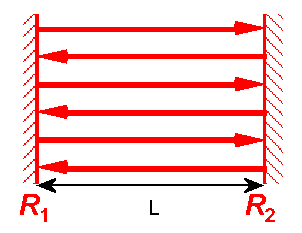
An optical resonator constructed with two mirrors that face each other provides feedback and delay.
The mirrors re-circulate, or feed back, the light with efficiency R = R1R2, the product of the reflectivities of the two mirrors. The delay time τ = 2L/c is the time it takes light to complete a round trip between the mirrors. The net gain for a complete round must be equal to unity to sustain steady oscillation, the gain must exactly compensate for the loss.
There is an additional criterion that after each round trip the light wave crests line up with the crests from the previous round trip. This results in a standing wave. The condition on the mirror separation is that one round trip contains an integral number of wavelengths 2L = mλ, where m is an integer. The corresponding resonant frequencies are fm = c/λ = mc/(2L). The separation between resonance frequencies is Δf = c/2L.
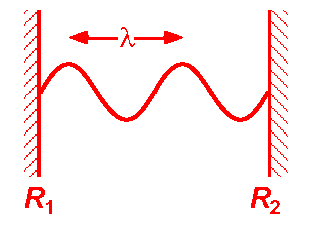
A typical visible wavelength laser resonator might have length L = 30 cm operating at wavelength λ = 600 nm so that m = 1 million. For an L = 30 cm resonator, the spacing between successive resonance frequencies is Δf = c/2L = 500 MHz while the resonance frequencies are near fm = c/λ = 500 THz, one million times larger.
The frequency of the laser transition can lie in a range Δf about f = E/h, since the energy of the levels has an uncertainty ΔE. Several of the resonance frequencies fm may fall into that range Δf. The spectrum emitted by a laser is a combination of the resonant frequencies fm that fall into that range Δf. A representative laser output spectrum is shown below.
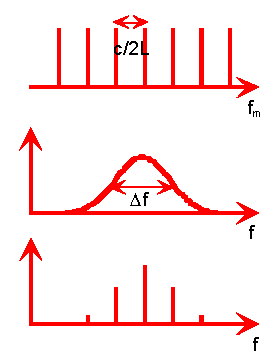
Modified laser resonators can suppress all but one of the resonant frequencies, permitting more precise control of the frequency, a desirable feature in scientific and engineering applications.
The He-Ne laser in the "Projects in Optics" kit supports three axial modes. The polarization of neighboring modes is orthogonal. It is possible to investigate these modes without resorting to high-resolution devices by using the Twyman-Green interferometer.
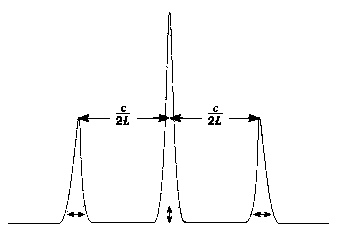
Assume our source emits waves with wavelength λ1 and λ2. Waves with wavelength λ1 and λ2 emitted in phase, will destructively interfere after some optical path length l'c = λ2/(2Δλ); l'c is often also called the coherence length. This definition of the coherence length differs from our previous definition by a factor of π.
The phase of a wave propagating into
the x-direction is given by φ = kx - ωt. Look at the wave pattern in space at
some time t. After some distance l the phase difference
between two waves with wave vectors k1 and k2 which are
in phase at x = 0 becomes Δφ = (k1 - k2)l.
When Δφ = π,
the two waves interfere destructively.
We therefore have
π = (k1 - k2)l'c
= (2π/λ - 2π/(λ + Δλ))l'c.
(λ + Δλ - λ)l'c/(λ(λ + Δλ)) ~ Δλl'c/λ2
= 1/2.
l'c
= λ2/(2Δλ).
Since λf = c, we have Δf/f
= Δλ/λ. We can write
l'c
= λ2/(2Δλ)
= λf/(2Δf)
= c/2Δf,
If we can measure l'c, we can
calculate Δf = c/2l'c.
Using the interferometer, we can measure the coherence length by monitoring the contrast of the fringes. When the interference maxima and minima of neighboring modes with λ1 and λ2 overlap, we observe high contrast fringes. If we move one of the mirrors a distance ΔL = l'c/2, so that the total path increases by l'c, then the maxima of one mode will overlap the minima of the neighboring mode and the fringe contrast will be greatly reduced. We have
Δf = c/2l'c = c/(4ΔL).
Open a Microsoft Word document to keep a live journal of your experimental procedures and your results. Include all deliverables, (data, graphs, analysis, outcome). Write a 'mini-reflection' immediately after finishing each investigation, experiment or activity, while the logic is fresh in your mind.
Part 1
Follow the instructions on pages 67 - 70 of the Projects in Optics Workbook, but simplify the setup described in steps 1-8 by using the procedure described below.


Measure the separation between the fringes and record the
spacing between two successive fringes.
By what distance does the path length from the test mirror to the observation screen change from one fringe to the next fringe?

Part 1 Deliverables: (to be included in the your journal)
Part 2
Follow the instructions on pages 71 - 74 of the Projects in Optics Workbook. You already have completed steps 1 - 10.
| initial position 0 max contrast |
position 1 min contrast |
position 2 max contrast |
position 3 min contrast |
Δf =c/4ΔL |
Laser length L |
Δf =c/2L |
|---|---|---|---|---|---|---|
Optional:
Part 2 Deliverables: (to be included in the your journal)
Laboratory 7 report: