Light is an electromagnetic wave. The electric field of a light wave propagating in the z-direction is given
by E = E0exp(i(kz - ωt)).
The time-averaged intensity of the wave is (1/(2μ0c))|E0|2.
Light is a transverse wave. E is a vector lying in the plane
perpendicular to z, E = (Ex, Ey).
Polarized light is produced when the direction of E in the plane
perpendicular to the direction of propagation is
constrained in some fashion.
The electric field vector E can always be resolved into two
perpendicular components. The light is elliptically polarized
when the two components have a constant phase
difference, and the tip of the electric field vector traces out an ellipse in
the plane perpendicular to the direction of propagation.
Ex = E0xexp(i(kz - ωt)), Ey = E0yexp(i(kz - ωt + φ)).
Linearly polarized light is a special case of elliptically polarized light.
If the light is linearly polarized, then the two
components oscillate in phase, for example
Ex = E0xexp(i(kz - ωt)),
Ey = E0yexp(i(kz - ωt)), φ
= 0.
The electric vector traces out a
straight line in a plane perpendicular to the direction of propagation of the
wave.
For example, E = Ei = E0xexp(i(kz -
ωt))i.
 Circularly polarized light is also a special case of elliptically polarized light,
in which E0x = E0y, and the two components have a 90° phase
difference. The electric field vector then traces out a circle in the plane
perpendicular to the direction of propagation. When viewed looking towards
the source, a right circularly polarized beam has a field vector that describes
a clockwise circle (φ = -π/2), while left
circularly polarized light has a field vector that describes a counter-clockwise circle
(φ = π/2) at a fixed position z.
Circularly polarized light is also a special case of elliptically polarized light,
in which E0x = E0y, and the two components have a 90° phase
difference. The electric field vector then traces out a circle in the plane
perpendicular to the direction of propagation. When viewed looking towards
the source, a right circularly polarized beam has a field vector that describes
a clockwise circle (φ = -π/2), while left
circularly polarized light has a field vector that describes a counter-clockwise circle
(φ = π/2) at a fixed position z.
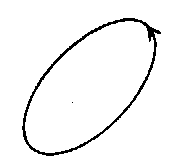
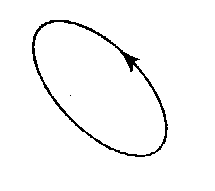
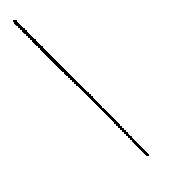
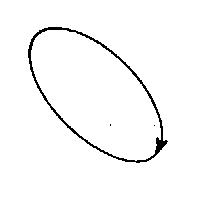
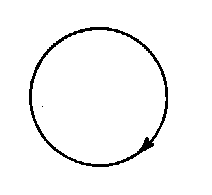
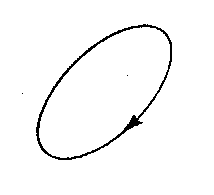
The figure below shows
the trace of the field vector Ex = E0cos(kz - ωt), Ey = E0cos(kz - ωt + φ) in a plane perpendicular to the
z-axis when looking towards the source. (E0x = E0y
= E0).
 |
 |
 |
 |
φ = 0
Ex = cos(ωt)
Ey = cos(ωt) |
φ = π/4
Ex = cos(ωt)
Ey = cos(ωt - π/4) |
φ = π/2
Ex = cos(ωt)
Ey = cos(ωt - π/2)
= sin(ωt) |
φ = 3π/4
Ex = cos(ωt)
Ey = cos(ωt - 3π/2) |
 |
 |
 |
 |
φ = π
Ex = cos(ωt)
Ey = cos(ωt - π)
= -cos(ωt) |
φ = 5π/4
Ex = cos(ωt)
Ey = cos(ωt - 5π/4) |
φ = 3π/2
Ex = cos(ωt)
Ey = cos(ωt - 3π/2)
= -sin(ωt) |
φ = 7π/4
Ex = cos(ωt)
Ey = cos(ωt - 7π/4) |
You can also open this Excel
spreadsheet
and explore.
It contains a macro, so you must download it to run it.
Summary:
Ex = E0xexp(i(kz - ωt)),
Ey
= E0yexp(i(kz - ωt + φ)).
- Linearly polarized light: φ = nπ,
n = 0, 1, 2, ...
- Circularly polarized light: E0x
= E0y, φ = nπ/2,
n = 1, 3, 5, ...
- Elliptically polarized light: φ =
arbitrary, but constant.
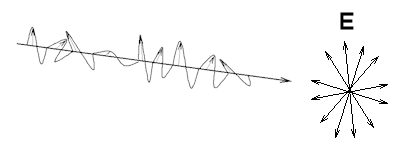
- Unpolarized light: φ, Ey, Ex are randomly
varying on a timescale that is much shorter than that needed for
observation.
Natural light is, in general, unpolarized.
AI Study Tip:
Example Prompt: 'Explain the difference between linear, circular,
and elliptical polarization using an analogy involving a person shaking a rope
tied to a wall. How does the 'phase shift' between the horizontal and
vertical components translate to the motion of the rope? Create a table
comparing the math (E-field equations) to the physical rope analogy.'