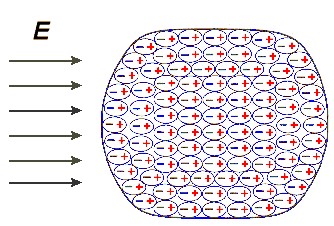
In some materials the outer electrons are firmly bound to their respective nuclei. They can be pulled more towards one or the other side of the nucleus they are bound to, but they cannot leave it. Those materials are dielectrics or insulators. Light waves can move through vacuum, but they also can move through transparent, dielectric materials. Even if a dielectric material is overall neutral, it can be polarized in the presence of an external electric field. Consider the case of a neutral dielectric insulator placed in an external field as shown in the figure below.
The electric field of the light wave attracts the electrons and repels the nuclei. The electrons are therefore no longer symmetrically distributed around their nuclei. This is the phenomenon of electrical polarization. Each atom or molecule acquires a dipole moment. For linear, isotropic, homogeneous (lih) dielectrics, the relative displacement of positively and negatively charged particles, and therefore the dipole moment, is proportional to the instantaneous magnitude of the electric field. The proportional constant is the same throughout the material, and the dipole moment always points in the direction of the electric field. The dipole moment per unit volume describes the induced polarization P of the medium. When an electromagnetic wave propagates through a material, the particles of the medium are also displaced from their equilibrium positions and the medium becomes polarized.
Not all materials are lih materials. All real materials, when exposed to a
high enough light intensity show a nonlinear response. But when the
magnitude of the external electric field is small and the material is isotropic and
homogeneous we usually have
P =
ε0χeE,
with the electric susceptibility χe = constant.
E is the total electric field at the position of each atom or molecule. It is the vector sum of the external field of the EM wave and the field produced by the surrounding polarized material. Since the field of the light wave is changing with time, the polarization is changing with time. Charges are moving and a changing polarization current is flowing. The polarization current density is just jp = ∂P/∂t. Maxwell's equations in a non-magnetic transparent material now lead to a wave equation with a source term.
∇2E -
μ0ε0∂2E/∂t2 =
μ0∂2P/∂t2.
Using
P =
ε0χeE this can be rewritten as
∇2E -
μ0ε0∂2E/∂t2 = μ0ε0χe∂2E/∂t2,
or
∇2E -
μ0ε0(1 + χe)∂2E/∂t2 =
0,
∇2E - [(1 + χe)/c2]∂2E/∂t2 =
∇2E - (1/v2)∂2E/∂t2
= 0.
We again obtain the homogeneous wave equation which has
sinusoidal plane waves solutions of the form
E(r,t) = Re(E0ei(k∙r - ωt)), B(r,t) = Re(B0ei(k∙r -
ωt)),
with ω/k = λf = v, where v = c/n.
n = (1 + χe)½ is called the index of refraction of the material.
We define fine ε
= ε0(1 + χe) = ε0κe,
where κe
is called the dielectric constant, and ε is called the permittivity of the
material.
In a transparent material a light wave move with speed v = c/n, where n is a property of the material.
Very few simple macroscopic media exist for which n is constant. For monochromatic, sinusoidal plane waves we often find that n(ω) depends on the frequency of the light, but not on other variables such as the magnitude and direction of the electric field. The medium is then dispersive, the speed v is a function of ω.