Reflection and refraction
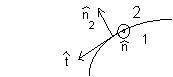 Maxwell's
equations tell us how electric and magnetic fields behave at boundaries between
different media. They yield the boundary conditions for the components of
E and B normal and tangential to the boundary. The unit vectors normal and tangential to the boundary
between medium 1 and medium 2 are defined in the figure on the right.
Maxwell's
equations tell us how electric and magnetic fields behave at boundaries between
different media. They yield the boundary conditions for the components of
E and B normal and tangential to the boundary. The unit vectors normal and tangential to the boundary
between medium 1 and medium 2 are defined in the figure on the right.
At boundaries between two non-magnetic dielectric materials the boundary
conditions are
(ε2E2 -
ε1E1)·n2 = 0, (B2 -
B1)·n2 = 0,
(E2 - E1)·t = 0, (B2 - B1)·t
= 0.
For waves propagating across a dielectric-dielectric boundary or
from a dielectric into a conductor we use that the tangential components of
E
and B are continuous across the boundary to derive the laws of reflection
and refraction and the ratio of the reflected and transmitted intensities to the
incident intensity.
 Reflection
Reflection is the abrupt change in the direction of propagation of a
wave that strikes the boundary between two different media. At
least some part of the incoming wave remains in the same medium.
Assume the incoming light ray makes an angle θi with the
normal of a plane tangent to the boundary. Then the reflected ray
makes an angle θr with this normal and lies in the same plane
as the incident ray and the normal.
Law of reflection: θi
= θr
Specular reflection
occurs at smooth, plane boundaries. Then the plane tangent to the
boundary is the boundary itself. Reflection at rough, irregular
boundaries is diffuse reflection.
The smooth surface of a mirror reflects light specularly, while the
rough surface of a wall reflects light diffusely.
 Refraction
Refraction is the change in direction of propagation of a wave when
the wave passes from one medium into another, and changes its speed.
Light waves are refracted when crossing the boundary from one
transparent medium into another because the speed of light is different
in different media.
Snell's
law, or the law of refraction: nisinθi = ntsinθt.
θr, and θt are the angles the incident and transmitted wave vectors make
with the normal to the boundary.
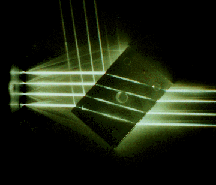 When light passes from one transparent medium to
another, the rays are bent toward the surface normal if the speed of
light is smaller in the second medium than in the first. The rays
are bent away from this normal if the speed of light in the second
medium is greater than in the first. The picture on the right
shows a light wave incident on a slab of glass.
When light passes from one transparent medium to
another, the rays are bent toward the surface normal if the speed of
light is smaller in the second medium than in the first. The rays
are bent away from this normal if the speed of light in the second
medium is greater than in the first. The picture on the right
shows a light wave incident on a slab of glass.
One part of the wave is reflected, and another part is
refracted as it passes into the glass. The rays are bent towards the
normal. At the second interface from glass into air the light passing
into the air is refracted again. The rays are now bent away from the
normal.
Reflectance and transmittance
At a boundary between two transparent media, light is partially reflected and
partially refracted. The ratio of the reflected intensity to the incident
intensity is called the reflectance R and the ratio of the transmitted intensity
to the incident intensity is called the transmittance T. Energy
conservation requires that R + T = 1 (if there is no absorption).
 R and T depend on the indices of refraction of the two media n1
and n2, the angle of incidence θ1,
and the polarization of the incident light. We distinguish between
p-polarization and s-polarization. Let the plane of incidence
contain the normal to the boundary and the incident wave vector k1.
The electric field vector E1 is perpendicular to k1.
If we choose our coordinate system as shown on the right, then plane of incidence is
the xz-plane and E1 may be written as E1= Ep+
Es. Ep lies in the xz-plane and Es
is perpendicular to the xz-plane, i.e. it points in the ±y-direction.
The electric field of the incident light is a linear superposition of p- and
s-polarized fields.
R and T depend on the indices of refraction of the two media n1
and n2, the angle of incidence θ1,
and the polarization of the incident light. We distinguish between
p-polarization and s-polarization. Let the plane of incidence
contain the normal to the boundary and the incident wave vector k1.
The electric field vector E1 is perpendicular to k1.
If we choose our coordinate system as shown on the right, then plane of incidence is
the xz-plane and E1 may be written as E1= Ep+
Es. Ep lies in the xz-plane and Es
is perpendicular to the xz-plane, i.e. it points in the ±y-direction.
The electric field of the incident light is a linear superposition of p- and
s-polarized fields.
For p-polarized light we have R = |r12p|2, where r12p
is the Fresnel reflection coefficient for p-polarization. We
have
r12p = tan(θ1
- θ2)/tan(θ1
+ θ2).
For s-polarized light we
have R = |r12s|2, where r12s is the Fresnel
reflection coefficient for s-polarization. We have
r12s
= sin(θ1 - θ2)/sin(θ1
+ θ2).
For an interactive graph of the reflectance R for s- and p-polarized light
as a function of n1, n2, and θ1, click on
the figure below to download the
Excel spreadsheet.

If θ1 +
θ2
= π/2,then tan(θ1 +
θ2) = infinite and
r12p = 0. If light is reflected, it will have
s-polarization.
The incident angle at which this happens is called the
Brewster angle θB.
We then
have
n1sinθB =
n2sin((π/2) - θB)
= n2cosθB, tanθB
= n2/n1.
Polarized light can thus be
obtained via reflection.
The subject of geometrical optics starts with the laws of refraction and
reflection for transparent media. These laws are used to discover the
properties of various optical systems, which may contain any number of
curved refracting and reflecting surfaces. In principle one could solve
any optical problem by the exact application of the basic laws. However,
it is possible to derive some very useful general results by using approximate
forms of the laws, which treat only rays, called paraxial rays, which make small
angles with respect to an optical axis. Often the treatment is confined to
spherical surfaces. This approximate form of the basic laws as applied to
paraxial rays in an optical system consisting of spherical surfaces is called
the first order theory and constitutes a major part of the subject of
geometrical optics.