
When light propagates from air into glass or from glass in to air it may
change its direction of travel. Snell's law reveals the relationship between the
directions of travel in the two media.
n1sinθ1 = n2sinθ2.
Consider light propagating in glass with index of refraction n1 =
1.5 towards a glass-air boundary. If the angle the light makes with the normal
to the boundary in the glass is θ1, then
the angle it makes in the air is given by
sinθ2 = (n1/n2)sinθ1
= 1.5 sinθ1.
If sinθ1 > (1/1.5) = 2/3, or
θ1 > 41.8o, then sinθ2
is greater than 1 and there is no solution for θ2.
The angle θ1 for which sinθ2
= 1 is called the critical angle θc. We
have sinθc
= n2/n1.
For angles
θ1 greater than the critical angle there
exists no solution for θ2, and there is no
refracted ray.
The incident light is totally reflected, obeying the law of
reflection. If n2 = 1.5 and n1 = 1 then the critical angle
is θc = 41.8o
Total internal reflection occurs only if light travels from a medium of high index of refraction to a medium of low index of refraction.
For angles greater than the critical angle the incident light is totally reflected, obeying the law of reflection.
A light source is at the bottom of a pool of water (n = 1.33). At what minimum angle of incidence will a ray be totally reflected at the surface?
Solution:
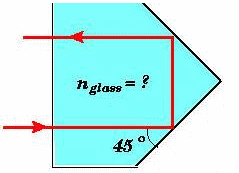 Problem:
Assume you are using total internal reflection to make a corner reflector. If there is air outside and the incident angle is 45.0o, what must be the minimum index of refraction of the material from which the reflector is made?
Solution: