 .
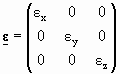
.Consider a plane wave with wave vector k propagating through a medium with a dielectric tensor
.
In a coordinate system with its axes along the principal axes, the equation D
= ε0n2E┴
for a component of D along one of the principal axes
becomes
εiEi = ε0n2(Ei
– (1/k2)ki(k∙E)),
since E┴
= E - ek(ek∙E)
= E
– (1/k2)k(k∙E)).
This can be rewritten as
εiΣj(δijEj) = ε0n2(Σj(δijEj)
– (1/k2)kiΣj(kjEj)),
or
 with
with
 .
.
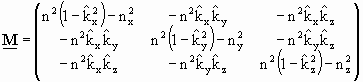
In matrix form this may be written as ME = 0, with
 .
.
Here we have used ni2 = εi/ε0.
If the εi are known, and we choose a particular direction of propagation ek for the wave front, then we can solve for E.
ME = 0 only if the characteristic equation is satisfied and det(M) = 0. The characteristic equation appears cubic in n2, but when written in terms of a polynomial in n2 the coefficients of the n6 terms vanish, leaving a quadratic equation in n2. This equation has two positive roots, n12 and n22.
For a given direction of propagation ek, there are in general two values for the refractive index, n1 and n2. We can solve for corresponding components of E up to a multiplicative constant. Let the solutions E1 and E2 correspond to n1 and n2, respectively.
We may resolve E into components parallel and perpendicular to ek.
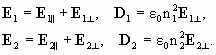
If n12 is not equal to n22, then D1 and D2 are perpendicular to each other.
If n12 is equal to n22, then the directions of D1 and D2 are arbitrary as long as they are perpendicular to ek and it is convenient to choose them perpendicular to each other.
If the parallel components of both E1 and E2 are not zero, then E1·E2 = E1|| ·E2|| ≠ 0. (Parallel refers to the direction of k.) The parallel components of E1 and E2 are only zero if the wave propagates along one of the principal axes of the crystal and the matrix M is diagonal.
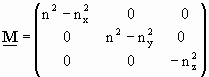
Let ek be the z-direction, i.e. the wave front propagates along the z-direction. Then k = kz and
 .
.
The characteristic equation det(M) = 0, or (n2-nx2) (n2-ny2) nz2 = 0 implies that n2 = nx2, or n2 = ny2, or nz2 = 0. But nz2 = 0 is not a physical solution, since εz > 0. We therefore have two solutions, n12 = nx2 and n22 = ny2.
The direction of E1 = D1/( ε0n12) corresponding to n1 is the x-direction and the direction of E2 = D2/( ε0n22) corresponding to n2 is the y-direction. E is parallel to D.
When D is not polarized along the x- or y-direction, then E is not parallel to D, as required. Such a wave does not propagate through the material. A wave propagating along a principal axis must be linearly polarized along one of the two remaining principal axes of the dielectric tensor. An arbitrarily polarized wave must be treated a linear superposition of two waves each linearly polarized along one of the two remaining principal axes, and these two waves propagate independently with different phase velocities.
The phase velocity of the wave polarized along the x-direction is c/n1, and the phase velocity of the wave polarized along the x-direction is c/n2.