Connectors are used to mate a fiber to another fiber or to equipment.
Good coupling efficiency requires precise positioning of the fiber. Connectors are used when one expects that
the connection must occasionally be broken.
Optical connectors are similar to their electrical
counterparts in function and outward appearance. They must, however, be high precision
devices. A connectors must center the fiber so that its light
gathering core lies directly over and in line with a light source or another
fiber to a tolerance of a few ten thousandths of an inch.
There are many different
types of optical connectors in use today.
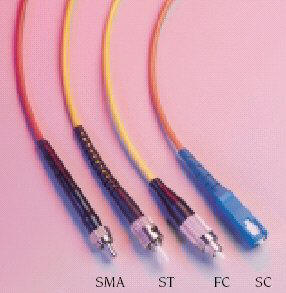
- The SMA connector was developed before the invention of single-mode
fiber. Due to its stainless steel structure and low-precision, threaded
fiber locking mechanism, this connector is used mainly in applications requiring
the coupling of high-power laser beams into large-core, multimode fibers.
Typical applications include laser beam delivery systems in medical and
industrial applications. The typical insertion loss of an SMA connector is
greater than 1 dB.
- The most popular type of
multimode connector in use today is the ST connector. Initially developed by
AT&T for telecommunications purposes, this connector uses a twist lock type design. Its high-precision, ceramic ferrule allows its use with both
multimode and single-mode fibers. A typical mated pair of ST connectors will exhibit less than 1 dB
(20%) of loss and does not require alignment sleeves or similar devices.
The inclusion of an "anti-rotation tab" assures that every time the
connectors are mated, the fibers always return to the same rotational position
assuring constant, uniform performance.
- The FC connector has become the
connector of choice for single-mode fibers, and is mainly used in fiber-optic
instruments, SM fiber optic components, and in high-speed fiber optic
communication links. This high-precision, ceramic ferrule connector is
equipped with an anti-rotation key, reducing fiber end-face damage and
rotational alignment sensitivity of the fiber. The key is also used for
repeatable alignment of fibers in the optimal, minimal-loss position. The typical
insertion loss of the FC connector is around 0.3 dB.
- The SC connector is
becoming increasingly popular in single-mode fiber optic telecom and analog CATV,
field deployed links. The high-precision, ceramic ferrule construction is
optimal for aligning single-mode optical fibers. The connector's outer, square
profile combined with its push-pull coupling mechanism, allow for greater
connector packaging density in instruments and patch panels. The keyed outer
body prevents rotational sensitivity and fiber end-face damage. The typical insertion loss of the
SC connector is around 0.3 dB.
Splices are permanent connections between two fibers made by arc-welding the
fibers together (fusion splicing) or gluing them together (mechanical splicing.)
Both splices are capable of splice losses in the range of 0.15 dB (3%) to 0.1 dB
(2%).
- In a mechanical splice,
the ends of two pieces of fiber are cleaned and stripped, then carefully butted
together and aligned using a mechanical assembly. A gel is used at the point of
contact to reduce light reflection and keep the splice loss at a minimum. The
ends of the fiber are held together by friction or compression, and the splice
assembly features a locking mechanism so that the fibers remained aligned.
- A fusion splice, by
contrast, involves actually melting (fusing) together the ends of two pieces of
fiber. The result is a continuous fiber without a break. Fusion splices require
special expensive splicing equipment but can be performed very quickly, so the
cost becomes reasonable if done in quantity. As fusion splices are fragile,
mechanical devices are usually employed to protect them.