 .
.Assume a ray starts in a medium with index of refraction n1 at
position (x1, y1, z1) and propagate in this
medium to a position (x2, y2, z2). If we
use the paraxial approximation, then, for propagation in a single medium we have
x2 = x1 + (z2 - z1)θ1x,
θ2x = θ1x,
y2 = y1 + (z2 - z1)θ1y,
θ2y = θ1y.
Assume a ray crosses a spherical interface with radius of curvature R. The ray crosses at a position with coordinates (x1, y1, z1). Assume that the medium in front of the interface has index of refraction n1 and the medium behind the interface has index of refraction n2.
If we use the paraxial approximation, then ths position (x1, y1, z1)
lies in the plane perpendicular to the z-axis containing the vertex, and for refraction at an interface for a ray going from a medium with n1 into
a medium with n2 we have
n2θ2x =
n1θ1x - (n2 - n1)x1/R,
x2 = x1,
n2θ2y =
n1θ1y - (n2 - n1)y1/R,
y2 = y1.
The equations can be written in matrix form.
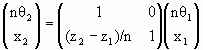
Let us concentrate on a ray in the xz-plane. We can then drop the index x on the angle, and we have for translation in a medium with index n
nθ2 =
nθ1 + 0*x1,
x2 = [(z2 - z1)/n]nθ1
+ x1,
or
.
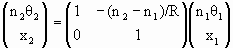
For refraction at an interface we have
n2θ2 = n1θ1 - [(n2 - n1)/R]x1or
 .
.
These transformations can be combined to give the overall transformation through several refracting and transmitting elements.
Assume a ray propagates in a medium with index of refraction n. Let the optical axis be the z axis. At any position z along this axis, a meridional ray is completely specified by giving its perpendicular distance from the axis and the angle θ it makes with the optical axis. Let us orient our coordinate system so that the ray lies in the xz-plane.
Assume a ray originates at (x1, z1) in medium 1. It makes an angle θ1 with the z-axis. We define the coordinates of the ray as
 .
.
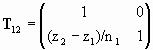
The ray propagates in medium 1 towards (x2, z2). The translation matrix T12 is given by
 ,
,
and the ray’s new coordinates are
 .
.
(Note that the determinant of the translation matrix T12 is 1.)
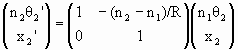
At z2 the ray encounters a spherical interface between medium 1 and medium 2 and is refracted. Its coordinates become
 ,
,
or
r2’ = Rr2 = RT12r1.
Here
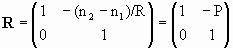 .
.
(Note that the determinant of the refraction matrix R is 1.)
P is called the power of the interface.
The ray then propagates in medium 2 towards (x3’, z3’). We have

or
r3’ = T23r2’ = T23RT12r1 = Mr1.
M is the system matrix. Its determinant is 1, since det(AB) = det(A) det(B).
Matrix multiplication yields M.

To form an image, all rays leaving the point P at (x1, z1) must arrive at the point P’ at (x3’, z3’), independent of θ1. This means that x3’ must be independent of θ1, or
 .
.
This can be rearranged to yield
 .
.
In terms of the object distance do and the image distance di from the
interface we write
n1/do + n2/di = (n2 - n1)/R.
A real image of an object produces the same pattern of light as the object does somewhere in space. Some portion of the light from the real image reaches our detector along a straight-line path. The detector cannot distinguish between light coming from the object and light coming from the image. We interpret the same patterns in the same way.
A virtual image is the apparent position from which a pattern of light reaches our detector, if we make the assumption that it has traveled from its source to the detector along a straight-line path. Virtual images are formed when light from an object or from an image is reflected or bend on the way to the detector.
Let us revisit
.
If z1 goes to –infinity, we have
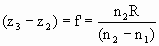 .
.
Similarly, if z3 goes to infinity, we have
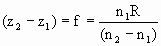 .
.
The distances f’ = n2/P and f = n1/P are called the image and object focal length, respectively.
Note: If n2 < n1, then f and f' are negative.
We define the lateral magnification Mx through the equation
x3' = Mxx1.
This yields
 .
.
Using from above
we obtain
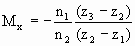 .
.
In terms of object and image distance we have
M = -(n1di)/(n2do).
If M is negative, the image is inverted.
AI Study Tip:
Example prompt: 'I am confused about the sign conventions for a single spherical interface. Create a summary table for me based on the 'Light Travels Left-to-Right' convention. Include columns for object distance, image distance, and radius of curvature. Then, give me a practice problem involving a virtual object behind a concave surface and walk me through the solution step-by-step to ensure I don't drop a negative sign.'