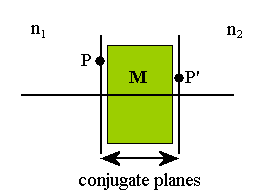
Definition:
Let P’ be the
image of a point P formed by some system of lenses. P
and P’ are called conjugate points and they lie in
conjugate planes.
The geometry and refracting characteristics of the optical system are contained in the transformation matrix M. If r1 characterizes a ray entering the optical system at P and r2 characterizes that same ray exiting the system at P’, then
 .
.
Since P’ is an image of P, x2 must be independent of θ1. We need M21 = 0.
We then have x2 = M22x1. Since x2/x1 is the lateral magnification mx, we have mx = M22.
For θ2 we have
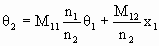 .
.
For two different rays leaving x1 and arriving at x2 we therefore have
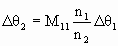 .
.
If we define the ray angle magnification mθ = Δθ2/Δθ1, then we have
 .
.
Since the determinant M equals 1, M11*M22 = 1.
This yields mxmθ(n2/n1) = 1, or (x2/x1)(Δθ2/Δθ1)(n2/n1) = 1, or n1x1Δθ1 = n2x2Δθ2 .
This is called the Lagrange equation, nxΔθ is known as the Lagrange invariant.
In terms of mx and mθ the overall transformation matrix between conjugate planes may be written as
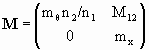 .
.
AI Study Tip:
Example prompt:
In Module 3, we define conjugate planes as planes where all rays from an object
point P meet at an image point P'.
Looking at the ray transfer equation,
,
explain mathematically why the condition for conjugate planes is M12
= 0. If M12 = 0, what does the M22 element represent
in terms of the image?
Give me a conceptual analogy for why the angle of the incoming ray θ1doesn't
matter when M12 = 0.
(Give the AI the link to Module 3).