Other aberrations
Curvature of field
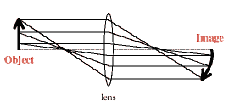 Curvature of field is not a point aberration, but an aberration associated
with an extended object.
Curvature of field is not a point aberration, but an aberration associated
with an extended object.
When extended objects are imaged with spherical lenses all transverse points on the image are in focus at the same time on a curved surface instead of on a plane. On a plane screen capturing the image, the center and the outer regions of an extended object are in focus at different distances away from the lens. This defect is called Petzval curvature or curvature of field defect.
AI Study Tip:
Example prompt: 'I am performing an experiment on Field Curvature.
I have brought the center of my object into focus, but the edges are blurry.
-- How can I mathematically prove this is 'Petzval Field Curvature' and not just
a misalignment of my screen?
-- If I want to see the edges in focus, should I move the screen closer to or
further from the lens?
-- How does this phenomenon explain why early cameras used curved film plates?"
Distortion
Another aberration associated with extended objects is distortion. Distortion results when the magnification is a function of the distance away from the optical axis. If we take the object in figure above and move it along the y-axis, then all rays leaving it are skew rays. This introduces distortion, the aberration associated with the coordinates normal to the symmetry axis. Distortion is what causes vertical lines to bulge outward (barrel distortion) or inward (pincushion distortion) at the image plane, depending on aperture placement.

Geometrical aberration summary:
Spherical Aberration: Spherical aberrations are point aberrations. Spherical aberrations are the consequence of the failure of meridional rays to obey the paraxial approximation. The image of a point light source on the optical axis is not a point is a blurry circle.
Coma: Coma is a point aberration. Coma is the failure of skew rays to match the behavior of meridional rays. The image of a point light source not on the optical axis is not a point but a blurry, wedge-shaped image.
Astigmatism: Astigmatism is a point aberration. The failure of the sagittal and tangential rays to produce a single image in a lens corrected for both spherical aberration and coma is known as astigmatism. The image of a point light source not on the optical axis is not a point. Its shape (horizontal line, blurry spot, vertical line) depends on the location of the image plane.
Curvature of Field: When extended objects are imaged with spherical lenses corrected for all point aberrations, all transverse points on the image are in focus at the same time on a curved surface instead of on a plane.
Distortion: For extended objects distortion results when the magnification is a function of the distance away from the optical axis.
Chromatic Aberration
Chromatic aberration results from material dispersion. Because different colors of light refract by different amounts, an image point formed by light of one color does not coincide with the corresponding image point formed by light of a different color. This is not a geometrical aberration.