
An important part of the design of an optical system is its efficiency in transferring light. One must be able to specify the amount of energy emitted or received. For historical reasons, many similar quantities are used to specify the amount of light leaving the source or arriving at the receiver, and many different systems of units are used. Only in recent years has the situation improved with the gradual changeover to the International System of Units (SI).
To specify the amount of energy emitted by a source, we use the quantities.
To specify the amount of energy received by a detector, we use one quantity.
A radian is the angle subtended at the center of a circle of radius r by a section of its circumference of length equal to r. Dividing 2πr by r gives 2π as the number of radians in a full circle.
A steradian is the solid angle subtended at the center of a sphere of radius r by a section of its surface area of magnitude equal to r2. Since the surface area is 4πr2, there are 4π steradians surrounding a point in space.
Let a cone of arbitrary shape have its apex at the center of a sphere of unit radius. The solid angle Ω at the apex is numerically equal to the surface area on the sphere intercepted by the cone, since the full sphere has an area of 4π.
When specifying energy, power, power per unit area, power per unit solid angle, and power per unit solid angle per unit projected area, we can specify radiometric quantities, which apply to radiation of any wavelength, or photometric quantities, which only apply to visible light.
In the figure above, let the area dS be the source of electromagnetic radiation. The area dS emits radiation toward a receiving area dS’ at a distance r.
The corresponding photometric quantities are tied to the sensitivity of the human eye, our main detector for visible light.
In SI units, the energy of the emitted radiation is measured in Joule. However, if the wavelength of the emitted radiation lies in the 400—700 nm range, i.e. the visible range, then the energy is called luminous energy and its unit is the Talbot.
The photometric equivalent of the radiant flux Φ is the luminous flux Φ, whose units are lumens (lm).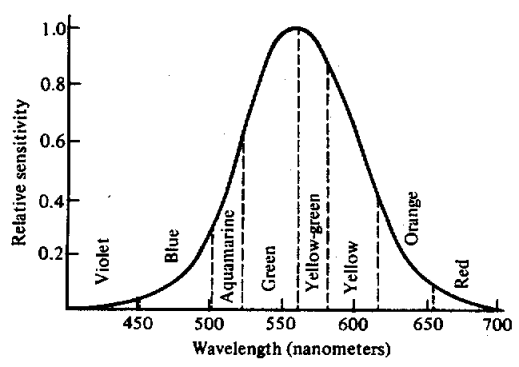
The figure above shows the sensitivity of the eye as a function of wavelength or color. The peak is in the green at 555 nm. 1 W of green light is equivalent to 683 lm.

If the energy supplied by dS is being received from another source and retransmitted isotropically, i.e. if dS is a perfect diffuser and its radiance or brightness is not a function of angle, then L = I/(dS cosθ) = I/dSn = constant and I(θ) = LdS cos(θ) is related to its normal component In by the equation
I(θ) = In cosθ.
This is known as Lambert’s law. A surface which satisfies Lambert’s law is called Lambertian. Lambertian refers to a flat radiating surface. (The flat surface can be an elemental area of a curved surface.) A Lambertian surface can be an active surface or a passive, reflective surface. The intensity I(θ) falls off as the cosine of the observation angle with respect to the surface normal (Lambert's law). The radiance (W/(m2sr)) is independent of direction. A good example is a surface painted with a good "matte" or "flat" white paint. If it is uniformly illuminated, like from the sun, it appears equally bright from whatever direction you view it.
 In the
figure on the right, if the source is Lambertian and equally bright
in all directions, then the amount of energy that falls each the detectors is
not the same for each of the detectors, but depends on the angle θ
as cosθ.
In the
figure on the right, if the source is Lambertian and equally bright
in all directions, then the amount of energy that falls each the detectors is
not the same for each of the detectors, but depends on the angle θ
as cosθ.
[Note: A source that is equally
bright in all direction does not emit the same amount of energy in all
directions. When determining the brightness of a small source we measure
the energy that falls on a detector subtending a given solid angle at the source
and then divide by the apparent size (area) of the source. A small source
emitting the same amount of energy into the given solid angle as a larger source
is brighter than the larger source.]
The apparent brightness of a Lambertian surface is the same when viewed from any angle. For a Lambertian surface only, we have the relation ship between the emittance M and the radiance L,
M = πL.
[L = d2P/(dΩ dS cosθ). If L is constant,
then
M = dP/dS = ∫Ω
L cosθdΩ = 2πL∫0π/2
cosθ sinθ dθ
= πL.]
The ratio of the radiant emittance (W/m2) to the radiance (W/m2sr) of a Lambertian surface is a factor of π and not 2π. The radiance is integrated over a hemisphere. The factor of cos(θ) in the definition of radiance is responsible for this result. It is counterintuitive, since there are 2π steradians in a hemisphere.
Consider a point P on a line normal to the center of a disk. The point is a distance a from the center of the disk, which has a radius R.
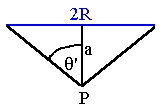
(a) Show that the solid angle subtended by the disk at the point is
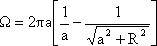 .
.
(b) Show that, when the point P is very far from the disk,
the solid angle reduces to zero.
(c) Show that, when P is very close to the disk, the solid
angle becomes 2π.
(d) Show that when R/a << 1 the expression for Ω
simplifies to Ω = πR2/a2.
(e) Explain physically what (b), (c), and (d) mean.
Solution:
 (a) Consider some surface S enclosing a point P.
Now imagine a small cone, which intersects an infinitesimal area, dA, on
S. The cone defines the solid angle
subtended by the area dA at point P. By
definition, the solid angle is the area dA projected on a plane perpendicular to
the radius vector r from P to dA, and divided by r2. If
dΩ is the solid angle subtended by dA we have If dΩ = er·dA/r2. The expression can be integrated over a region of S to find
the total solid angle subtended by that region.
(a) Consider some surface S enclosing a point P.
Now imagine a small cone, which intersects an infinitesimal area, dA, on
S. The cone defines the solid angle
subtended by the area dA at point P. By
definition, the solid angle is the area dA projected on a plane perpendicular to
the radius vector r from P to dA, and divided by r2. If
dΩ is the solid angle subtended by dA we have If dΩ = er·dA/r2. The expression can be integrated over a region of S to find
the total solid angle subtended by that region.
 Thus if the apex of a cone lies at the center of a sphere,
the solid angle subtended is the ratio of the sphere surface area enclosed by
the cone to the square of the radius of the sphere.
Thus if the apex of a cone lies at the center of a sphere,
the solid angle subtended is the ratio of the sphere surface area enclosed by
the cone to the square of the radius of the sphere. .
.
 .
.
 .
.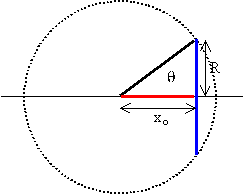 A lens with a diameter of 1.25 in. and a focal length of 2.0 in. projects the
image of a lamp capable of producing 3,000 cd/cm2. Find the
illuminance E in lm/ft2 (footcandles) on a screen 20 ft from the
lens.
A lens with a diameter of 1.25 in. and a focal length of 2.0 in. projects the
image of a lamp capable of producing 3,000 cd/cm2. Find the
illuminance E in lm/ft2 (footcandles) on a screen 20 ft from the
lens.
Solution:
AI Study Tip:
Example prompt: 'Describe the relationship between the diameter of the
entrance pupil and the depth of field in a camera system. If I want to
keep the same exposure (radiometric flux) but double the depth of field, what
adjustments must be made to the shutter speed and aperture?'