The power radiated by thermal sources is a function of their temperature. We divide thermal sources into two classes, black-body radiators and line sources.
Kirchoff's laws of spectroscopy characterize thermal emission of light from matter.
Quantum mechanics governs the internal structure of atoms and allows us to elaborate on Kirchoff's Laws.
Radiation laws govern the properties of the continuous spectrum.
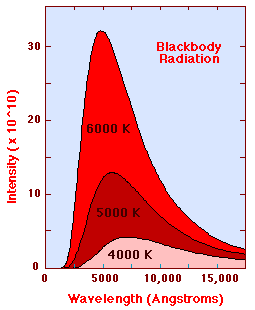 The primary law governing radiation is the Planck Radiation Law,
which gives the intensity of radiation emitted by a blackbody as a
function of wavelength for a fixed temperature. The Planck law gives a
distribution, which peaks at some wavelength. The peak shifts to shorter
wavelengths for higher temperatures, and the area under the curve grows rapidly
with increasing temperature. The diagram below shows the intensity
distribution predicted by the Plank law in J/(m2s) for blackbodies at
various temperature.
The primary law governing radiation is the Planck Radiation Law,
which gives the intensity of radiation emitted by a blackbody as a
function of wavelength for a fixed temperature. The Planck law gives a
distribution, which peaks at some wavelength. The peak shifts to shorter
wavelengths for higher temperatures, and the area under the curve grows rapidly
with increasing temperature. The diagram below shows the intensity
distribution predicted by the Plank law in J/(m2s) for blackbodies at
various temperature.A blackbody is a body that absorbs all the radiation that falls onto it. It does not reflect any radiation. It reaches thermal equilibrium with its surroundings, and in thermal equilibrium emits exactly as much radiation it absorbs. It has emissivity = 1. Emissivity measures the fraction of radiative energy that is absorbed by the body.
The Wien Law gives the wavelength of the peak of the radiation distribution, λmax = 3*106/T. Here λ is measured in units of nanometer (10-9 m) and T is in Kelvin.
The Stefan-Boltzmann Law gives the total energy being emitted at all wavelengths by the body.
Radiated power = emissivity * σ * T4 * Area
Here σ is the Stefan-Boltzmann constant, σ = 5.67*10-8 W/(m2K4). Light colored or reflective objects have low emissivity. They do absorb a smaller percentage of the incoming radiation than do dark objects, and also emit radiation less readily.
The Wien law explains the shift of the peak to shorter wavelengths as the temperature increases, while the Stefan-Boltzmann law explains the growth in the height of the curve as the temperature increases. This growth is very abrupt, since it varies as the fourth power of the temperature.
The Planck radiation law tells us the intensity of the radiation emitted by a hot object as a function of wavelength. The Wien Law gives the wavelength of the peak of the distribution. The surface temperature of the sun is 5800oC = 6073 K. The wavelength of the peak of the distribution therefore is 494 nanometer. This wavelength lies in the yellow region of the visible spectrum.
In an incandescent light bulb a filament is heated to approximately 2500oC = 2773 K. This is the maximum temperature that a tungsten filament can stand without evaporating quickly. Compared to the sun, such a filament emits a greater fraction of its radiation in the infrared region of the electromagnetic spectrum. The wavelength of the peak of the distribution is 1082 nanometer. This wavelength lies in the infrared region of the spectrum.
Sunlight and light from an incandescent bulb contain all the colors of the visible spectrum. But the intensity distribution over the different colors is different. Sunlight appears brilliant white while a light bulb looks yellowish.