 ,
,Fresnel diffraction theory is a scalar diffraction theory. It ignores the vector nature of the electromagnetic field.
Assume a scalar field E(x,y,z,t) = E(x,y,z)exp(-iωt) is a solution to the scalar wave equation
∇2E(x,y,z,t) - (1/c2)∂2E(x,y,z,t)/∂t2 =
0,
∇2E(x,y,z) + k2E(x,y,z)/∂t2 =
0, k2 = ω2/c2, k = 2π/λ.
Assume space is divided into two regions separated by a surface S.
Region 1 contains the sources of the field E(x,y,z). These sources produce
a wave incident on the surface S, which separates region 1 from region 2.
The field everywhere in region 2 is a solutions of
∇2E(x,y,z) + k2E(x,y,z)/∂t2 =
0,
and can be found if the field E
and its normal derivative ∂E/∂n on
the surface S are known.
The assumptions that are usually made are that E(x,y,z)
and ∂E/∂n vanish
everywhere on S except where there is an opening.
The values of E(x,y,z)
and ∂E/∂n in the opening
are equal to the values of the incident wave in the absence of any obstacle or
screen.
The standard calculations of classical optics are all based on this approximation. They have only limited validity. They are valid in the paraxial approximation. (In the paraxial approximation the direction of the electromagnetic fields is constant to first order, so ignoring the vector nature can be justified.)
So let us keep on working in the paraxial approximation. Assume the surface S is located in the z = 0 plane. Region 1 is the z
< 0 region. In the paraxial approximation the wave vectors of all plane
waves make small angles with respect to the z-axis, so that we can write
kz = (k2 – kx2
– ky2)½ ≈ k –
(kx2 + ky2)/2k.
Any E(x,y,z) may be expanded in terms of plane waves.
The general
solution to
∇2E(x,y,z) + k2E(x,y,z)/∂t2 =
0 in region 2 is
E(x,y,z) = ∫-∞∞dkx∫-∞∞dky u0(kx,ky)exp(i(kxx + kyy + kzz)),
where u0(kx,ky) is the amplitude of the plane wave solution with frequency ω and the particular transverse components kx and ky of the wave vector. In the paraxial approximation we may write
E(x,y,z) = eikz∫-∞∞dkx∫-∞∞dky u0(kx,ky)exp(i(kxx + kyy))exp(-i(kx2+ky2)z/(2k)).
If in region 2 we write E(x,y,z) = u(x,y,z)exp(ikz), then
u(x,y,z) = ∫-∞∞dkx∫-∞∞dky u0(kx,ky)exp(i(kxx + kyy))exp(-i(kx2+ky2)z/2k).
In order for the paraxial approximation to be valid, u0(kx,ky)
must vanish unless (kx2+ky2)/2k <<
1.
If we set z = 0 then we see that u0(kx,ky) is
the inverse
Fourier transform of u(x,y,z=0).
u(x,y,z=0) = ∫-∞∞dkx∫-∞∞dky
u0(kx,ky)exp(i(kxx + kyy)).
[Fourier transform:
Let f(x) = ∫-∞∞f(k)exp(ikx)dk.
Then f(k) =(1/(2π)) ∫-∞∞f(x)exp(-ikx)dx.
Define u(x0,y0) = u(x,y,z=0).
u(x0,y0) = ∫-∞∞∫-∞∞u0(kx,ky)exp(i(kxx0
+ kyy0))dkxdky. Then
u0(kx,ky) = (1/(2π))2∫-∞∞∫-∞∞u(x0,y0)exp(-i(kxx0
+ kyy0))dx0dy0.]
Therefore the field in a plane at z is related to the field in the z = 0
plane through
u(x,y,z) = (2π)-2∫-∞∞dx0∫-∞∞dy0
u(x0,y0)∫-∞∞dkx∫-∞∞dky
exp(i(kx(x-x0) + ky(y-y0))exp(-i(kx2+ky2)z/2k).
We can evaluate k-space integral by completing the square in the exponent.
∫-∞∞dkxexp(i((x-x0)kx
- z/(2k)kx2)) = ∫-∞∞dkxexp((-iz/(2k))[(-2k(x-x0)/z)kx
+ kx2]
= ∫-∞∞dkxexp((-iz/(2k))[(kx
- k(x-x0)/z))2 - (k(x-x0)/z)2]
= exp(ik(x-x0)2/(2z))∫-∞∞dkxexp((-iz/(2k))[(kx
- k(x-x0)/z))2]
= √(-i2kπ/z) exp(-ik(x-x0)2/(2z)) =2π√(-i/(λz)) exp(-ik(x-x0)2/(2z)),
using ∫-∞+∞exp(-a(x+b)2)dx
= √(π/a).
Therefore
(2π)-2∫-∞∞dkx∫-∞∞dky
exp(i(kx(x-x0) + ky(y-y0))exp(-i(kx2+ky2)z/2k)
= [-i/(λz)]exp(-ik(x2 + y2)/(2z)),
and
u(x,y,z) = [-i/(λz)]∫-∞∞dx0∫-∞∞dy0
u(x0,y0)exp(-ik((x-x0)2 + (y-y0)2)/(2z)),
where u0(x0,y0) is the known distribution at
z = 0. This is called the Fresnel diffraction integral.
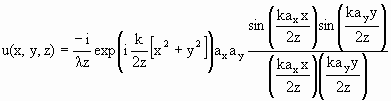
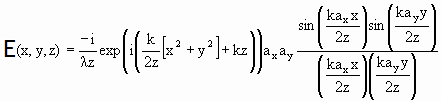
Now consider the Fraunhofer approximation for a rectangular aperture.
Assume u(x0,y0)
= 1 if |x0| < ax/2, |y0| < ay/2
and zero otherwise, and let z/k >> axay.
Then we may approximate
k((x-x0)2 + (y-y0)2)/(2z) =
[k/(2z)](x2+y2-2xx0-2yy0).
We then can evaluate the integral for u(x,y,z). We find
,
 .
.
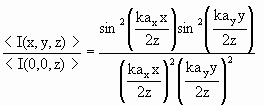
The intensity distribution is proportional to |E|2.
 .
.
AI Study Tip:
Example prompts:
'I am a student in an upper-level undergraduate Modern Optics course. We are currently studying Module 6: Diffraction. Please act as a Socratic tutor. Ask me a series of questions, one at a time, to help me derive the conditions for Fraunhofer vs. Fresnel diffraction. Once I answer, tell me if I am correct and explain the physical significance of the 'far-field' approximation in the context of phase changes across an aperture.'
'I am looking at the Fraunhofer diffraction integral. Can you break down the mathematical meaning of each term in the integral? Specifically, explain why the diffraction pattern is essentially the Fourier Transform of the aperture function. Use simple language first, then show the mathematical connection.'