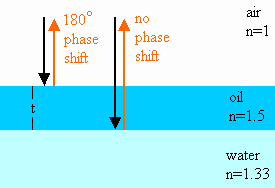
 Consider the case of a thin film of oil of thickness t
floating on water. For simplicity, assume that the light is
incident normally, so that the angle of incidence and the angle of
reflection are zero
Consider the case of a thin film of oil of thickness t
floating on water. For simplicity, assume that the light is
incident normally, so that the angle of incidence and the angle of
reflection are zeroWe can set up division of amplitude interference by dividing the amplitude of the incident beam is divided into two or more parts either by reflection, partial reflection or refraction.
When the medium through which a wave travels abruptly changes, the wave may be partially or totally reflected. When a light wave reflects from a medium with a larger index of refraction, then the phase shift of the reflected wave with respect to the incident wave is π or 180o. When a light wave reflects from a medium with a smaller index of refraction, then the phase shift of the reflected wave with respect to the incident wave is zero.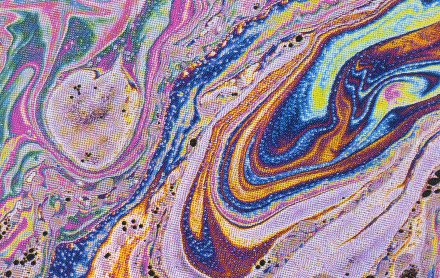 Thin-film interference
is the interference of light waves reflecting off the top surface of a thin
film with the waves reflecting from the bottom surface. Constructive and destructive interference
of reflected light waves causes the colorful patterns we often observe
in thin films, such as soap bubbles and layers of oil on water. If the thickness of
the film is on the order of the wavelength of light, then colorful
patterns can be obtained, as shown in the image on the right. For simplicity, assume that the light is incident
normally, so that the angle of incidence and the angle of reflection are
zero.
Thin-film interference
is the interference of light waves reflecting off the top surface of a thin
film with the waves reflecting from the bottom surface. Constructive and destructive interference
of reflected light waves causes the colorful patterns we often observe
in thin films, such as soap bubbles and layers of oil on water. If the thickness of
the film is on the order of the wavelength of light, then colorful
patterns can be obtained, as shown in the image on the right. For simplicity, assume that the light is incident
normally, so that the angle of incidence and the angle of reflection are
zero.
Consider the case of a thin film of oil of thickness t
floating on water. For simplicity, assume that the light is
incident normally, so that the angle of incidence and the angle of
reflection are zero
In the air, the light reflecting off the air-oil interface will have a 180o phase shift with respect to the incident light. A 180o phase shift is equivalent to the light having traveled a distance of ½ wavelength. In the oil, the light reflecting from the oil-water interface will have no phase shift with respect to the light incident on the interface. For the light reflected off the oil and the light reflected off the water to constructively interfere we need the two reflected waves to have a phase shift of an integer multiple of 2π or 360o. If the light reflected off the oil-water interface travels an additional distance equal to ½ the wavelength of the light in oil, then the total phase shift with respect to the light reflected off the air-oil interface will be 2π. This happens if the thickness t of the film is equal to 1/4 the wavelength of the light in oil, since the light has to traverse this thickness twice. We also get constructive interference if the thickness of the film is equal to 3/4, 5/4, ..., the wavelength of the light in oil. For constructive interference we need
2t = (m+½)λn, m = 0,1,2,...,
where λn is the wavelength of the light in oil.
In vacuum we have λf = c. In a medium with index of refraction n we have λnf = c/n. The frequency of oscillation is the same
in vacuum and in a medium, therefore
λn= λ/n.
For constructive interference we therefore need
2 noil t = (m+½)λ, m = 0,1,2,....
Destructive interference occurs when the thickness of the oil film is equal
to (½)λn, λn, (3/2)λn, etc.
For destructive interference we therefore need
2 noil t = mλ, m = 0,1,2,....
If the thickness of the film is (1/4)λn = (1/4)λ/noil the phase of the wave reflected off the top surface is shifted by π by the reflection. The phase of the wave traveling through the film is not shifted by reflection off the bottom surface, but the wave travels an extra distance of λn/2. It will therefore be in phase with the wave reflected off the top surface. If, on the other hand, the film thickness is ½λn, = ½λ/noil then the wave traveling through the film travels an extra distance of one wavelength. It will therefore be out of phase with the wave reflected off the top surface and the two waves will cancel each other out.
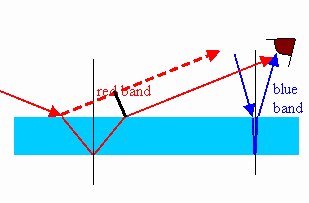 Waves incident at an angle θi on the air oil
interface are refracted as they enter the oil. The angle of refraction θt
is found from Snell's law, nairsinθi = noilsinθt. If they are reflected off the second interface, then they travel a
distance 2t/cosθt in the oil. When they emerge again from the
oil into the air and propagate parallel to the waves reflected at the
air-oil interface, then the total optical path length difference is
Waves incident at an angle θi on the air oil
interface are refracted as they enter the oil. The angle of refraction θt
is found from Snell's law, nairsinθi = noilsinθt. If they are reflected off the second interface, then they travel a
distance 2t/cosθt in the oil. When they emerge again from the
oil into the air and propagate parallel to the waves reflected at the
air-oil interface, then the total optical path length difference is
2 noil t/cosθt - 2d tanθtsinθi
= 2 noil t/cosθt - 2d tanθt(noil/nair)sinθt
= 2noilt/cosθt(1 - sin2θt)
= 2 noil t cosθt.
For constructive interference we therefore need
2 noiltcosθt = (m+½)λ, m =
0,1,2,…,
and for destructive interference we need
2 noil t cosθt = mλ, m = 1,2,….
Constructive and destructive interference occur at different angles for different wavelength. The observer sees colored bands.
The destructive interference of reflected light waves is utilized to make non-reflective coatings. Such coatings are commonly found on camera lenses and binocular lenses, and often have a bluish tint. The coating is put over glass, and the coating material generally has an index of refraction less than that of glass. Then the phase shift of both reflected waves is 180°, and a film thickness equal to 1/4 of the wavelength of light in the film produces a net shift of ½ wavelength, resulting in cancellation. For such non-reflective coatings the minimum film thickness t required is
t = λ/4n,
where n is the index of refraction of the coating material. A coating with thickness t = λ/4n prevents the reflection of most of the light with a wavelength λ close to λ = 4nt. The coating does not reflect a specific range of wavelengths. Often that range is chosen to be in the yellow-green region of the spectrum, where the eye is most sensitive. Lenses coated for the yellow-green region reflect in the blue and red regions, giving the surface a familiar purple color.
When sunlight reflects from a thin film of soapy water, the film appears multicolored, in part because destructive interference removes different wavelengths from the light reflected at different places, depending on the thickness of the film. As the film becomes thinner and thinner, it looks darker and darker in reflected light, appearing black just before it breaks. The blackness means that destructive interference removes all wavelengths from the reflected light when the film is very thin. Explain.
Solution:
A thin film of a material is floating on water (n = 1.33). When the material has a refractive index of n = 1.20, the film looks bright in reflected light as its thickness approaches zero. But when the material has a refractive index of n = 1.45, the film looks black in reflected light as the thickness approaches zero. Explain these observations in terms of constructive and destructive interference and the phase changes that occur when light waves undergo reflection.
Solution: