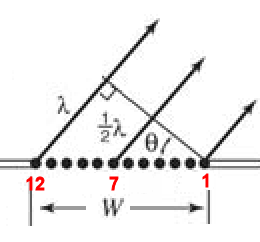
 Consider a slit of width w, as shown in the
diagram on the right. A plane wave is incident from the bottom and all points oscillate in phase inside the slit.
Consider a slit of width w, as shown in the
diagram on the right. A plane wave is incident from the bottom and all points oscillate in phase inside the slit.When light passes through a single slit whose width w is on the order of the wavelength of the light, then we can observe a single slit diffraction pattern on a screen that is a distance L >> w away from the slit. The intensity is a function of angle. Huygens' principle tells us that each part of the slit can be thought of as an emitter of waves. All these waves interfere to produce the diffraction pattern. Where crest meets crest we have constructive interference and where crest meets trough we have destructive interference.
Very far from a point source the wave fronts are essentially plane
waves. This is called the Fraunhofer regime, and the diffraction pattern is called Fraunhofer diffraction. The positions of all
maxima (constructive interference) and minima (destructive interference) in the
Fraunhofer diffraction pattern can be calculated fairly easily.
The positions of the first minimum in the Fraunhofer diffraction pattern from a single slit can be found
from the following simple arguments.
Consider a slit of width w, as shown in the
diagram on the right. A plane wave is incident from the bottom and all points oscillate in phase inside the slit.If the optical path length of two rays differs by λ/2, the two rays interfere destructively. For ray 1 and ray 7 to be half a wavelength out of phase we need
(w/2)sinθ = λ/2 or w sinθ = λ.
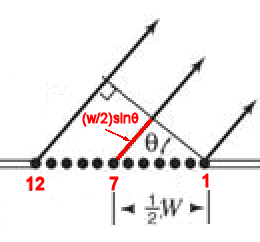 But from geometry, if these two rays interfere destructively, so do rays 2 and
8, 3 and 8, and 6
and 10, 5 and 11, and 6 and 12.
But from geometry, if these two rays interfere destructively, so do rays 2 and
8, 3 and 8, and 6
and 10, 5 and 11, and 6 and 12.
In effect, light from one half of the opening interferes destructively
and cancels out light from the other half.
Destructive interference produces
the dark fringes. Dark fringes in the diffraction pattern of a
single slit are found at angles θ for which
w sinθ = mλ,
where m is an integer, m = 1, 2, 3, ... . For the first dark fringe we have w sinθ = λ.

When w is smaller than λ , the equation w sinθ = λ has no solution and no dark fringes are produced.
 Problem:
When a monochromatic light source shines through a 0.2 mm wide slit onto a screen 3.5 m away, the first dark band in the pattern appears 9.1 mm from the center of the bright band. What is the wavelength of the light?
Solution:
Consider a single slit diffraction pattern for a slit width w. It is observed that for light of wavelength 400 nm the angle between the first minimum and the central maximum is 4*10-3 radians. What is the value of w?
Solution: