Consider a wave propagating through space. Coherence is a measure of the correlation that exists between the phases of the wave measured at different points. The coherence of a wave depends on the characteristics of its source.
Let us look at a simple example. Imagine two corks bobbing up and down on a wavy water surface. Suppose the source of the water waves is a single stick moved harmonically in and out of the water, breaking the otherwise smooth water surface. There exists a perfect correlation between the motions of the two corks. They may not bop up and down exactly in phase, one may go up while the other one goes down, but the phase difference between the positions of the two corks is constant in time. We say that the source is perfectly coherent. A harmonically oscillating point source produces a perfectly coherent wave.
When we describe the coherence of light waves, we distinguish two types of coherence.
Temporal coherence is a measure of the correlation between the phases of a light wave at different points along the direction of propagation. Temporal coherence tells us how monochromatic a source is.
Assume our source emits waves with wavelengths λ ± Δλ. Waves with wavelength λ and λ + Δλ, which at some point in space constructively interfere, will no longer constructively interfere after some optical path length lc = λ2/(2πΔλ); lc is called the coherence length.
[The phase of a wave propagating into the x-direction is given by
φ
= kx - ωt. Look at the wave pattern in
space at some time t. At some distance l the phase
difference between two waves with wave vectors k1 and k2
which are in phase at x = 0 becomes Δφ = (k1
- k2)l. When Δφ = 1, or Δφ ~ 60o, the light is no longer considered coherent.
Interference and diffraction patterns severely loose contrast.
We therefore have
1 = (k1 - k2)lc = (2π/λ - 2π/(λ + Δλ))lc.
(λ + Δλ - λ)lc/(λ(λ + Δλ)) ~ Δλlc/λ2
= 1/2π.
lc = λ2/(2πΔλ).]
The wave pattern travels through space with speed c.
The
coherence time tc
is tc = lc/c. Since λf
= c, we have Δf/f = Δω/ω = Δλ/λ. We can write
lc = λ2/(2πΔλ)
= λf/(2πΔf) = c/Δω,
tc = 1/Δω.
If we know the wavelength or frequency spread of a light source, we can calculate lc and tc. We cannot observe interference patterns produced by division of amplitude, such as thin-film interference, if the optical path difference greatly exceeds lc.
AI Study Tip:
Example prompt: 'I am studying temporal coherence in my optics course. Given a light source with a central wavelength of λ = 632.8 nm and a spectral width of Δλ = 0.002 nm walk me through the calculation for the coherence length lc. Then explain how this coherence length would change if I used a white light LED instead. Why does this make the LED unsuitable for long-path interference experiments?
Spatial coherence is a measure of the correlation between the phases of a light wave at different points transverse to the direction of propagation. A wave front is an imaginary surface representing corresponding points of a wave that vibrate in unison. The wave fronts of spatial coherence waves are approximately flat over a certain distance.
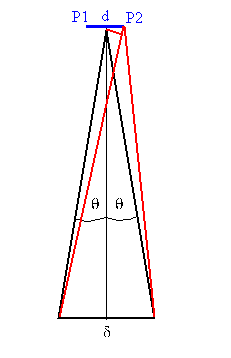
A distance L from a thermal monochromatic (line) source whose linear dimensions are on the order of δ, two slits separated by a distance greater than dc = 0.16λL/δ will no longer produce a recognizable interference pattern. We call πdc2/4 the coherence area of the source.
[At time t look at a source of width δ a perpendicular distance L from a screen. Look at two points (P1 and P2) on the screen separated by a distance d. The electric field at P1 and P2 is a superposition of the electric fields of the waves emitted by all source points, whose emissions are not correlated. In order for EM waves leaving P1 and P2 to produce a recognizable interference pattern, the superpositions at P1 and P2 must stay in phase.
screen
source of width δ
Light waves emitted from the two edges of the source have a some definite phase
difference right in the center between the two points at some time t. A ray traveling
from the left edge of δ
to point P2 must travel a distance ~d(sinθ)/2
farther then a ray traveling to the center. The path of a ray
traveling from the right edge of δ
to point P2 travel is ~d(sinθ)/2 shorter then the
path to the center. The path difference for the two rays therefore is dsinθ, which introduces a phase difference
Δφ' = 2πdsinθ/λ. For
the distance from P1 to P2 along the wave front we therefore get a phase difference Δφ
= 2Δφ' = 4πdsinθ/λ.
Wavelets emitted from the two edges of the source are that are in phase at
P1 at time t are out of phase by 4πdsinθ/λ
at P2 at the same time t. We have sinθ ~ δ/(2L),
so Δφ = 2πdδ/(Lλ).
When Δφ = 1 or Δφ ~ 60o,
the light is no longer considered coherent.
Δφ
= 1 --> d = Lλ/(2πδ)
= 0.16 Lλ/δ.]
An incandescent light bulb is an example of very incoherent source.

We can produce coherent light from an incoherent source if we are willing to throw away a lot of the light. We do this by first spatially filtering the light from the incoherent source to increase the spatial coherence, and then spectrally filtering the light to increase the temporal coherence.

AI Study Tip:
Example prompt: 'Explain the concept of 'coherence area' to me using the analogy of two corks bobbing in water. If I have a distant star (a very small angular source) versus the Sun (a large angular source), which one has a larger spatial coherence area on Earth? Use the formula dc ≈ λL/δ to justify why we can observe interference from starlight but struggle to do so with a nearby large lamp.'