For a monochromatic plane wave in a lih material v = 1/(εμ)˝
= c/n. The index of refraction is n = c(εμ)˝.
For most dielectric materials μ ~ μ0,
and n = (ε/ε0)˝. For a linear, isotropic, homogeneous material we have P =
ε0χeE, and
ε =
ε0(1 + χe).
The permittivity
ε is determined by how easily a material can be
polarized.
In a non-magnetic material let us define H = B/μ0
and D = ε0E + P.
In a
non-magnetic material with polarization P, Maxwell’s equations can then
be written in macroscopic form as
(1) ∇∙D = ρf,
(2) ∇×E = -∂B/∂t,
(3) ∇·B = 0,
(4) ∇×H = jf + ∂D/∂t.
(SI units)
Let us assume that the material contains no free charges, ρf
= 0, jf = 0. Then
∇∙D = 0, ∇×E = -μ0∂H/∂t,
∇∙H = 0,
∇×H = ∂D/∂t.
If we are looking for plane wave solutions that satisfy these equations, i.e.
E(r,t) = E0exp(i(k·r-ωt)),
D(r,t) = D0exp(i(k·r-ωt)),
H(r,t) = H0exp(i(k·r-ωt)),
then we need
k∙D = 0, ik×E = iμ0ωH,
k∙H = 0,
ik×H = -iωD.
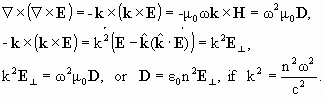
In a lossless macroscopic medium, Maxwell's equations (k∙D = 0) require that for any direction of propagation ek of a sinusoidal plane electromagnetic wave, D is perpendicular to ek. Here ek is the unit vector pointing in the direction of the wave vector k. We also have from Maxwell's equations
D is always perpendicular to k, i.e. D is perpendicular to the normal to the wave front. This is not necessarily true for E. D and E are not necessarily parallel vectors. Maxwell's equations in macroscopic form do not, in general, require, that for plane waves propagating through the medium E is perpendicular to k, as is the case for plane waves propagating through free space or a lih material.
Consider a linear, homogeneous, nonmagnetic, anisotropic medium. For such a medium the magnitude of the polarization vector P is proportional to the magnitude of E, but P and E are not necessarily parallel vectors.
Assume that in a material the electron moves in a potential that has a local minimum and that near this minimum can be modeled as an anisotropic harmonic oscillator potential. In a simple model in two dimensions, we may picture the electron in a square box, connected by strong springs to the right and left walls and by weak springs to the top and bottom walls.
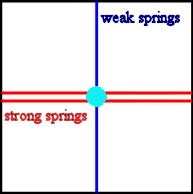
Let a force of
magnitude Fh = F' pointing towards the right produce a
displacement of magnitude d and a dipole moment of magnitude -qed.
Let a force of magnitude Fv = F' pointing
upwards produce a displacement of magnitude 2d and a dipole moment
of magnitude -2qed.


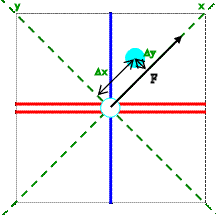
If we choose the coordinate system shown in the figure below and apply a force F = Fh + Fv in the x-direction, then this force produces a displacement Δx = (d, 2d)·(1/√2, 1/√2) = 3d/√2 in the x-direction and a displacement Δy = (d, 2d)·(-1/√2, 1/√2) = d/√2 in the y-direction. The dipole moment and the polarization therefore have a x- and a y-component. If the force F is due to an electric field E, then P and E are not parallel vectors.
In a linear, homogeneous, nonmagnetic, anisotropic medium we have for the Cartesian components of P,
Pi = ε0 ΣjχijEj,
with i, j = 1, 2, 3 = x, y, z.
In vector form we write P = χ ∙ E, where
χ denotes the susceptibility tensor.
We have
Di = ε0Ei
+ Pi = ε0 Σj(δij
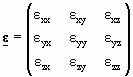
+ χij)Ej = ΣjεijEj, or D = ε ∙ E,
where ε denotes the dielectric
tensor.
 .
.
D and E are not necessarily parallel vectors.
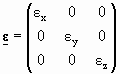
For a lossless (non-absorbing) medium that has no optical activity, the elements of ε are real and ε is a real, symmetric tensor. For such a tensor we can always find a Cartesian coordinate system in terms of which its matrix is diagonal. In that coordinate system ε has real elements and is of the form
 .
.
The quantities εx, εy, and εz are called the principal values of ε. They are all non-negative and in general are functions of the frequency ω. The directions of the eigenvectors of the matrix ε are the principal axes.
Now consider a plane wave with wave vector k propagating through this medium.
For a given direction of propagation ek, there are in general two values for the refractive index, n1 and n2. We can solve for the corresponding components of E up to a multiplicative constant. (See mathematical details.)
Results:
Let the solutions E1 and E2 correspond to
n1 and n2, respectively.
If n12 is not equal to n22, then D1
and D2 are perpendicular to each other.
If n12 is equal to n22, then the
directions of D1 and D2 are arbitrary as
long as they are perpendicular to
ek and it
is convenient to choose them perpendicular to each other.
If the parallel components of both E1 and E2 are not zero, then E1·E2 = E1|| ·E2|| ≠ 0. (Parallel refers to the direction of k.)
The parallel components of E1 and E2 are only zero if the wave propagates along one of the principal axes of the crystal.
AI Study Tip:
Example prompt: 'Explain the physical meaning of the electric susceptibility tensor χ in anisotropic materials. How does it differ from the scalar χ in isotropic materials, and what does it imply about the direction of the induced polarization vector P relative to the electric field vector E?'
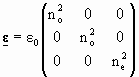
Consider a uniaxial crystal with the diagonal dielectric tensor
 ,
,
(a) Show that a circularly polarized wave with the field E
= E0j + iE0k at x = 0, propagating in the
crystal along the x-axis, becomes periodically linearly polarized. A
plate of the appropriate thickness so as to transform circularly polarized light
into linearly polarized light is called a quarter-wave plate.
(b) Find the thickness d of a quarter wave plate in terms
of no, ne, and the free-space wavelength l.
Solution:
Show that the quarter wave plate of the previous problem can transform linearly polarization at its "input" into circular polarization at its "output" and determine the angle of E with respect to the y-axis.
Solution: