Non-linear optics
When an electromagnetic wave propagates through a material, the particles of the medium are displaced from their equilibrium positions. Positively charged particles move in the direction of the electric field, while negatively charged particles move in the direction opposite to the direction of the electric field. This relative displacement of positively and negatively charged particles creates dipole moments. The dipole moment per unit volume describes the induced polarization P of the medium.
In a linear material the relative displacement of positively and negatively charged particles is proportional to the instantaneous magnitude of the electric field. But all real materials, when exposed to a high enough light intensity show a nonlinear response. In return the medium modifies the electromagnetic field in a nonlinear way.
When the magnitude of the external field is small, the magnitude of the electric polarization is approximately linearly proportional to the electric field E. In anisotropic materials we write
P = ε0χE,
where χ is the electric susceptibility tensor.
When the magnitude of external electric field is large, the induced polarization has a nonlinear dependence on the electric field and can be expressed as a power series with respect to the electric field. In an isotropic material we have
P = ∑nε0χ(n)En.
In an anisotropic material P and En can have a different direction.

χ(1) is the linear susceptibility responsible for linear absorption
and refraction.
χ(2) is the first non-linear term. It only is
nonzero in anisotropic materials. In a medium with inversion symmetry
about the origin the transformation r --> -r does not alter the
medium. If we imagine a polarization P produced by E and
reverse the sign of E, then the sign of P must change, because the
medium itself is invariant under such a transformation. All term of even
power in the above equation do not reverse their sign, and therefore all
coefficients χ(2m) must be equal to zero for media with
inversion symmetry.
χ(3) is the second non-linear
term, which can be nonzero in all materials.
Electric fields associated with light from ordinary non-coherent sources are usually too small to trigger an observable nonlinear response. But the magnitude of electric fields from pulsed laser beams focused onto a small spot can approach the magnitude of typical internal fields in crystals. In general it takes fields greater than of 105 V/m to observe nonlinear optical phenomena. These optical fields are easily generated by lasers. Equally important, the coherence of the laser light makes it possible to observe many nonlinear phenomena. When the molecules in the material respond coherently to the laser light, even the weakest nonlinear effects can be detected.
Assume E is proportional to cos(ωt). Then P is is proportional to cos(ωt) in a linear material. All charges oscillate with angular frequency ω and produce electromagnetic wave with angular frequency ω. In nonlinear materials P also contains non-negligible terms that are proportional to E2 and therefore to cos2(ωt) = (1/2)(1 + cos(2ωt)), and maybe terms proportional to E3 and therefore to cos3(ωt) = (1/4)(cos(3ωt) + 3cos(ωt)). The displacement of the charges is a superposition of a constant displacement and oscillations with angular frequencies ω, 2ω, and maybe 3ω. The material generates EM wave with twice or three times the frequency of the incident light and also a constant electric field.
What are possible consequences?
The nonlinear index of refraction is defined as a variation of the index of refraction of the material proportional to the intensity of the light propagating through the medium. Let us consider an optical wave propagating through an isotropic material with inversion symmetry (χ(2) = 0). The linear susceptibility χ(1) is related to the ordinary index of refraction in the linear regime.
n0 = (1 + χ(1))½ .
In the nonlinear regime the magnitude of the polarization can be expressed as:
P = ε0 (χ(1)E + χ(3)E3).
This yields
D = ε0E + P = ε0(1 + χ(1) + χ(3)E2)E = εE.
The index of refraction is
n = (ε/ε0)½ = (1 + χ(1) + χ(3)E2)½ ~ n0(1 + (χ(3) E2)/2n02) = n0 + n2I,
where I is the intensity of the optical wave, I ∝ E2, and n2 represents the nonlinear index of refraction, which depends on the intensity of the applied field. The nonlinear index of refraction is responsible for self-focusing and soliton propagation in fibers.
Self-focusing
An intense optical beam increases the index of refraction n at the peak of its profile if n2 > 0. This, in effect, produces an optical wave guide, it produces spatial variations of n and ε, and the beam focuses to a point. This behavior is responsible for optical damage in high-power laser systems.
Solitons
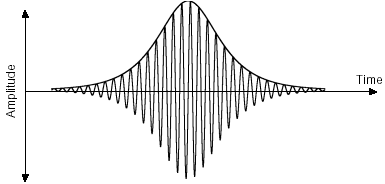
A soliton is a wave pulse, which can propagate over long distances without any distortion of its waveform. Dispersion is counteracted by the nonlinear index of refraction. A soliton, once formed, propagates undisturbed through a fiber in spite of fiber dispersion.
Link: A primer in optical soliton theory
Optical limiting is a nonlinear optical process in which the transmittance of a material decreases with increasing incident light intensity. Optical limiters are one of the most important types of devices used to control the amplitude of high intensity optical pulses. Ideal optical limiters have a linear transmittance at low input intensities. Above the threshold intensity the transmittance becomes constant.
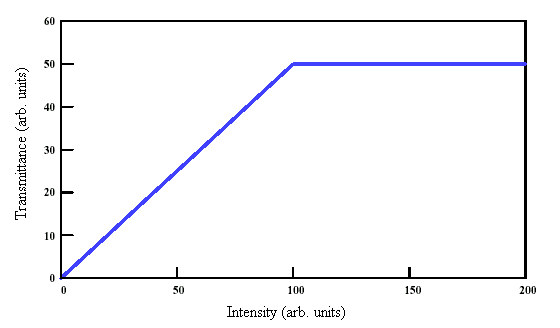
Optical limiting can be used for pulse shaping and pulse compression. But its main applications are sensor and eye protection. Photonic sensors, including the human eye, are damaged if the intensity exceeds a threshold intensity. Optical limiters extend the dynamical range of the sensors, allowing them to function at higher incident intensities. Good optical limiter should have:
- low input threshold
- wide dynamic range
- fast optical response
- broadband response
- high linear transmittance
- low optical scattering
- good mechanical, temperature, humidity stability
No material can satisfy all these requirements, but practical devices can be build from a combinations of various optical limiters.
Thermal nonlinearities arise from the absorption of radiation which leads to heating of the material. As a consequence, the local density changes, and this in turn will modify the index of refraction of the material.
Wave mixing processes
The electro-optic effect is a nonlinear effect that mixes a static field with the field of and electromagnetic wave. If an isotropic dielectric is placed in an electric field E and an intense beam of light is passed through the sample perpendicular to the field, then the material displays induced birefringence proportional to E2. The ordinary and the extraordinary ray propagate in the same direction perpendicular to E, but the index of refraction is different for the ordinary and extraordinary ray. Δn = no - ne = λKE2, where K is the Kerr coefficient.
The Kerr effect is a third order effect, and it is sometimes referred to as the quadratic electro-optic effect. It can be generated in materials with any molecular orientation. It can be used to construct wave plates.
Certain crystals exhibit a linear electro-optic effect. Birefringence occurs when the material is placed in an electric field E and a beam of light passes through the material parallel to the field. The ordinary and the extraordinary ray propagate in the same direction parallel to E, but the index of refraction is different for the ordinary and extraordinary ray. The induced birefringence is proportional to E. Δn = n0KpE where Kp is the Pockels coefficient, and n0 is the index of refraction of the material with no field applied. The linear electro-optic effect (LEO) or Pockels effect is a 2nd-order nonlinear effect. It does not occur in isotropic media or media with inversion symmetry. The Pockels effect can also be used to construct wave plates.
Both the Pockels and the Kerr effects can be used to construct very fast optical shutters (10-10 s) by placing the material between crossed polarizers. When the retardation is λ/2, the device will be transparent. Pockels cells typically require 5 to 10 times lower voltages than equivalent Kerr cells.
Second harmonic generation is a second order nonlinear process (ω + ω --> 2ω).
AI Study Tip:
Example prompt: 'I am studying Module 11 of my optics course. Can you explain second harmonic generation (SHG) and why it requires a non-centro-symmetric crystal? Specifically, relate it to the power series expansion of polarization Pi = ε0(χij(1)Ej + χijk(2)EjEk). Why does the second-order term leads to frequency doubling?'
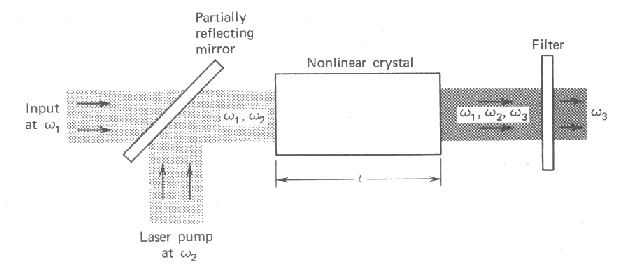
Parametric up-conversion in a crystal can be used to convert a signal from a low frequency ω1 to a high frequency ω3 by mixing it with a strong laser beam of frequency ω2 (ω1 + ω2 --> ω3).
Parametric amplification involves an input signal at at ω1 together with an intense pump beam at ω2, ω2 > ω1. A photon of the pump beam with frequency ω2 interacts with a photon with frequency ω1 and splits into two photons, one with frequency (ω2 - ω1) and one with frequency ω1. The coupling is provided by the non-linearity of the crystal. The wave at ω1 is amplified. This is accompanied by the generation of an idler beam at ω3 = ω2 - ω1. The idler beam then interacts with the pump beam to produce additional amounts of signal and idler light. A photon of the pump beam with frequency ω2 interacts with a photon of frequency ω3 = ω2 - ω1 and splits into two photons, one with frequency ω2 - ω3 = ω1 and one with frequency ω3.
In most materials the index of refraction depends on the wavelength of the EM wave. EM waves with different angular frequencies ω propagate with slightly different speeds. Consider, for example, second harmonic generation. Light with frequency 2ω generated at some point P1 in the medium will not be in phase with light with frequency 2ω generated at some other point P2. As a result, the two waves from P1and P2 will interfere destructively at some point P3. The problem of destructive interference can be overcome by letting the fundamental be the ordinary ray and the second harmonic be the extraordinary ray in an anisotropic crystal. When the direction of propagation of the fundamental is chosen so that the index of refraction of the fundamental and second harmonic are the same, both waves will stay in phase. The crystal then is said to be phase-matched or index-matched. Phase matching can also be achieved in some crystals by varying their temperature. The extraordinary index is in general more temperature-dependent than the ordinary index. By varying the temperature one can adjust the birefringence of the crystal until phase matching is obtained.
AI Study Tip:
Example prompts:
- Explain the concept of phase matching in nonlinear crystals. Why is it necessary for efficient energy transfer in frequency doubling, and how do experimentalists use birefringent phase matching to satisfy both energy and momentum conservation?
- In a nonlinear optics experiment, if I double the intensity of the incident laser, how should the intensity of the second harmonic generation signal change? Explain the quadratic relationship and what happens if the crystal is not properly aligned (phase mismatch).