Geometrical optics is the model we use if the wavelength of the light is very small compared to the dimensions of the equipment used to set up an optical system, and if the the photon energies are much smaller than the energy sensitivity of the equipment. Then light can be modeled as a collection of rays.
Geometrical optics predicts that in a medium with constant index of refraction a ray's path is a straight line. At an interface of two media with different indices of refraction n and n', the ray obeys Snell’s law, n sinθ = n' sinθ'. When reflecting from a surface, the ray obeys the law of reflection, θincident = θreflected.
Often we use geometrical optics to study image formation by reflection or refraction at spherical interfaces. If we restrict ourselves to rays that stay close to the optical axis of an optical system, we can study image formation using the paraxial approximation. In this approximation spherical surfaces can form perfect images. In the paraxial approximation a ray's behavior at each spherical interface and its propagation between interfaces is described by a 2 by 2 matrix, and the ray is traced through the optical system by multiplying these 2 by 2 matrices.
If the paraxial approximation is not valid, and the ray does not stay close to the optical axis, then spherical interfaces do not form perfect images. The image of a point is no longer a point, but a blob. The shape of the blob depends on the object points position and on where exactly we put the image plane. We can define various types of aberrations.
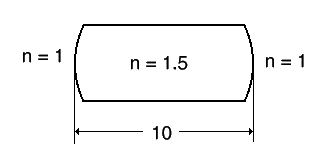
A thick biconvex lens in air has a radius of curvature of 10 cm at each surface and the surfaces are 10 cm apart. Find the focal points and the focal lengths of the lens if the index of the glass of the lens is 1.50.
Solution:
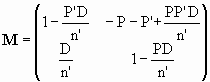
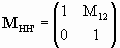
n1/S1 + n2/S2 = Psyst,
f' = n2/Psyst, f = n1/Psyst.
Here f' is the image focal length, when the object distance goes to -∞, f is the
object focal length, when the image distance goes to ∞.
Let the lens be a biconcave thick lens with radii of 10 cm, index 1.5, thickness 1 cm. Show that f = f'= -9.84 cm, VF = -10.16 cm, V 'F ' = -10.16 cm.
Solution:
A biconvex lens of index 1.50 has radii 10 cm and 20 cm, a thickness of 10 cm. Air is to the left of V and water (of index 4/3) is to the right of V '. Show that f' = 24 cm, f = 18 cm, V 'F ' = 16 cm, VF = 17 cm.
Solution: